








Your pages don’t match what people search for
Before I design, I know what your customers type. Structure and copy follow real search terms.
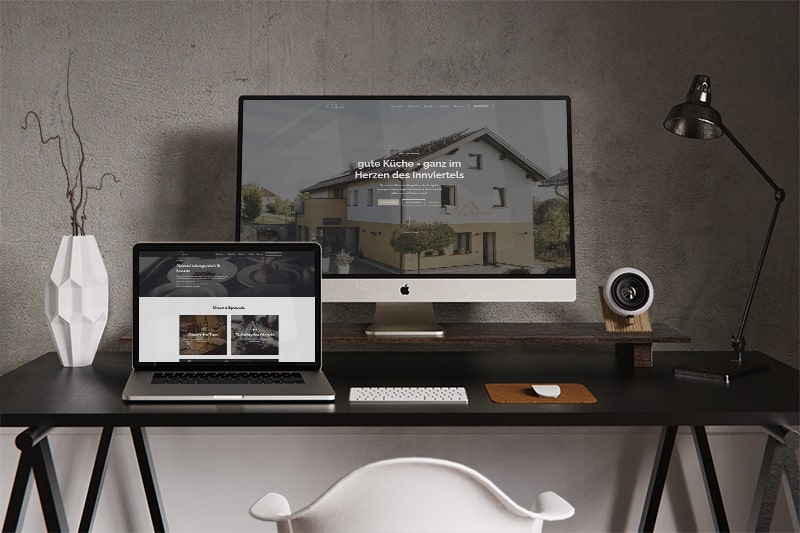
Most agencies treat web design and SEO as separate jobs. With me, both happen at the same time.


The difference
SEO web design combines two disciplines that run separately at most agencies. When both happen in parallel, you get a website with a clear advantage.
Before I design, I know what your customers type. Structure and copy follow real search terms.
With me, sitemap, URLs and headings follow a logic – for Google and for your visitors.
With me, meta titles, descriptions and schema markup are written alongside the design – not as an afterthought.

In practice
For a long time, reservations there came in almost only by phone. Every call tied up time and staff, in the middle of service. Today about 70% of à la carte reservations are made online.
“About 70% of our reservations are made online, and we save a lot of time on the phone.”Sibylle & Florian Schlöglmann · Wirt z’Kraxenberg
One page per search
Anyone searching for something specific wants to find exactly that. That’s why every search gets its own page.
One search, its own page, a booked table. That’s why SEO web design has more pages: one for every search that happens every month.
Web design or SEO web design
Both are the same website from me. The difference is the goal, and that decides where I start.
Structure and design come out of the first call. Every page has a visible path to an inquiry, tested mobile-first and handed over technically clean.
Here the work starts with keyword research, not with the layout. Structure, URLs and content are built per search term — that’s more work and therefore costs more.
What you get
Everything from web design, with two differences: the page plan carries the search terms, and after launch you get three monthly reports.
Which page answers which search. Settled before the first draft is made.
Not a PDF mock-up but the site itself, on your phone, with in-progress versions.
On your domain, with a certificate, fast on mobile. Measured, not promised.
Both belong to you, not me. You can see for yourself what you’re found for.
30 minutes together, plus the recording. Text, images, prices: you can change it all yourself.
Rankings, clicks, inquiries. What was fine-tuned, and what comes next.
The process
Like web design, with one more week at the start for the search terms and three months of monitoring afterwards.
Which searches happen in your area, how often, and who’s on top today?
You: 30 min. One conversation. You tell me what you want to be found for.
You get: keyword sheet
One page per search, with its title, its URL and what has to be at the top.
You: 45 min. Approve the page plan. Gather images and documents.
You get: page plan with search terms
The website is built, with each page’s copy written for its search.
You: 2 × 20 min. Click through two in-progress versions on your phone.
You get: preview link
Sitemap, Search Console, Business Profile, structured data for Google.
You: 30 min. Training, recorded.
You get: website, live
Every week I check rankings and clicks and adjust wherever things stall.
You: 10 min. a month Read the monthly report.
You get: three monthly reports
I look at your website and tell you within 24 hours what’s really holding it back.
Request a website analysisPrice
A fixed price after the first call. The research and the extra pages are the difference from web design.
The site that brings in new guests.
Basics
So you understand what you get, here are the key points from an SEO point of view.
Every URL clearly describes what’s on the page. No cryptic codes. Search engines read URLs, and so do people.
H1, H2, H3 in a logical hierarchy. One page, one main topic. Subtopics cleanly separated.
What’s visible at the top decides time on page and click-through rate. This is where it has to be clear what you offer.
Schema markup for local business, FAQ and services. It helps Google classify your page correctly.
Copy that answers real questions. No filler sentences, no keyword stuffing.
HTTPS as standard, mobile performance above 90, load time on a phone under three seconds.
Consistent details everywhere, a well-kept Google Business Profile, local search terms placed where they make sense.
FAQ
In regular web design, the look comes first. SEO is added later, if at all. In SEO web design, both disciplines run in parallel. Keyword research, URL structure and heading structure are built with the design, not after it. That saves money and gets better results from day one.
An SEO-optimized website for a small business starts at around $3,500. Depending on the scope, a booking system or a store, it can go higher. You get an exact estimate after the strategy call.
You often see first rankings for your brand name and local terms within the first two to four weeks. Stable top rankings for stronger keywords take three to six months.
Both have their place. Google Ads brings clicks right away but costs money for as long as it runs. SEO takes time but brings visitors for the long term with no cost per click. For local businesses, SEO is usually the more sustainable route.
It stays online until the new one is ready. At launch I set up clean redirects from all old URLs to the new ones, so you don’t lose any rankings or backlinks.
If your website is already structurally fit for SEO, ongoing SEO support is often enough. If your site is more than five years old or built from a template, rebuilding it often costs as much as a new one.
Yes. That’s exactly what it’s made for. Restaurants, hotels, beauty salons, medical practices and service providers with a clear local area benefit most. Local search is less competitive, but the people searching really want something.
Directly with me. From the strategy call to launch and beyond. No project manager in between, no changing contacts.
We can work out the copy and images together. Many clients provide some first content, and I structure and optimize it for SEO. If you have nothing at all, that’s no problem either.